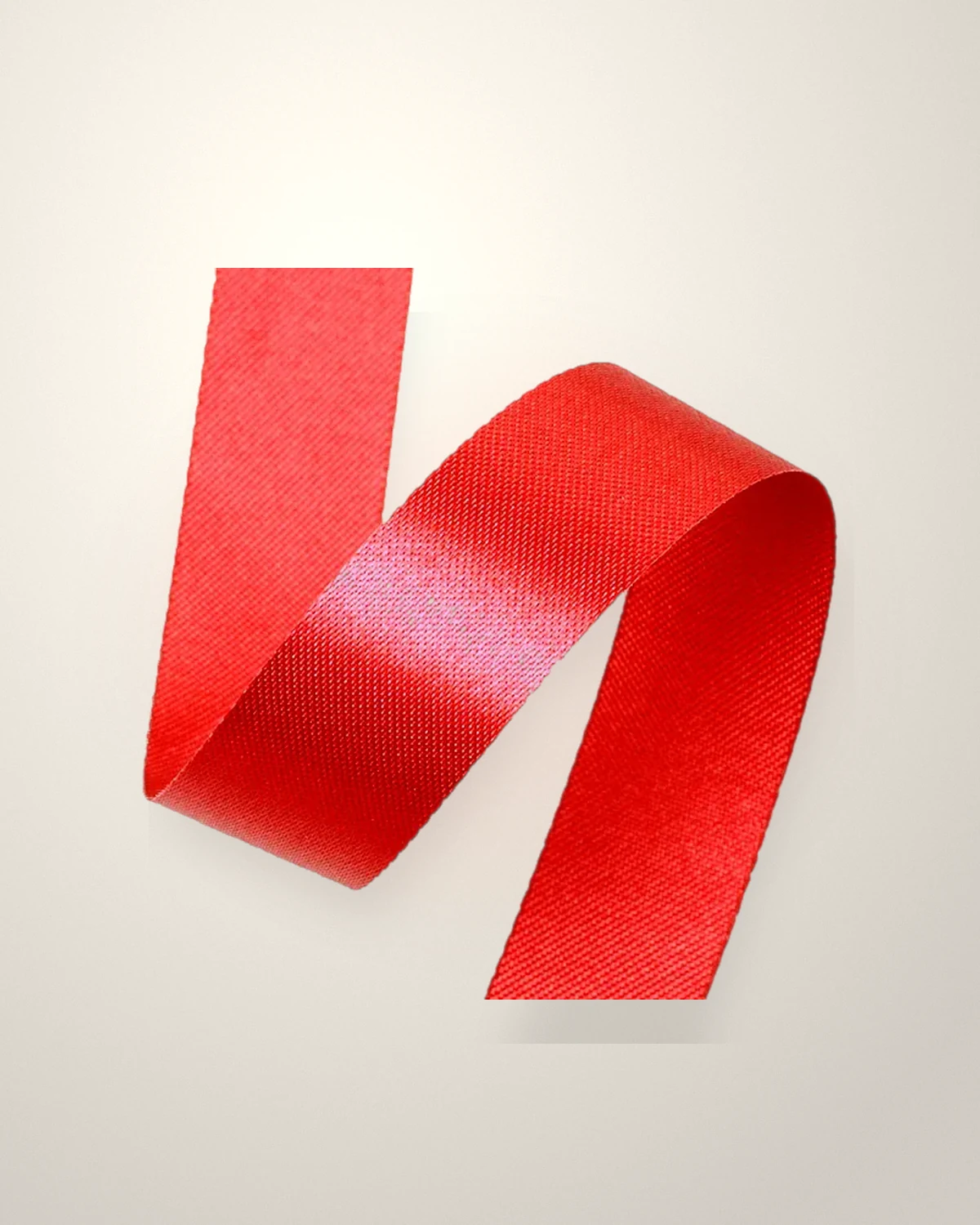
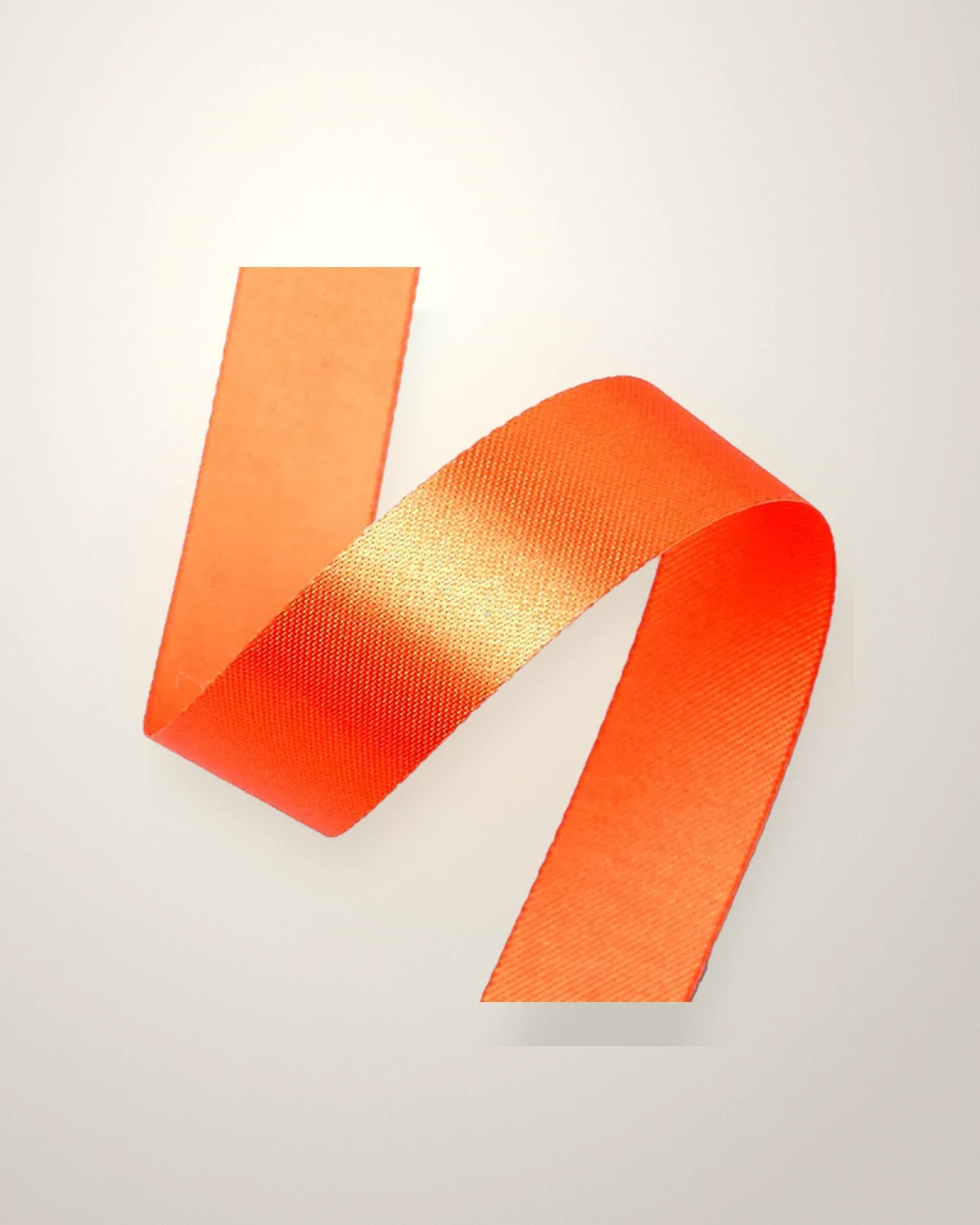
A ribbon is chosen first by its width. Colour comes next, then material. Width decides the gesture: a flat knot, a bow that holds, a tie that grips without marking the paper. The catalogue lists sixteen widths, from 3 mm to 300 mm, and each one has a use that is not up for debate.
Three widths, three gestures
10 mm is the ribbon of small things: a tag, a jewellery box, a bookmark, an invitation. In satin, the 10 mm red (ref. 80230) costs 9.50 € for a 100 m roll, which is 0.095 € per metre. It is the most economical width for anyone who ties often: a flat knot takes under 30 cm.
15 mm is the reference width for gift wrapping. It works on a shoebox, a book, a bottle. Satin 15 mm black (ref. 80245) and satin 15 mm red (ref. 80250) are 11.90 € per 100 m. It is also the width for invitations and menus: a fine, legible knot that does not eat the typography.
25 mm and 40 mm cover large surfaces: a corporate gift box, a hamper, a table napkin, a ceremony arch. Satin 25 mm red (ref. 80161) costs 16.60 € per 100 m. Satin 40 mm sand (ref. 80173) reaches 23.80 € per 100 m, but one knot is enough to hold a large carton.
The widths people forget
3.5 mm is a thread, not a ribbon: it ties a tag to a jar, a pendant to an invitation, a spoon to a small parcel. Satin 3.5 mm orange (ref. L12) comes in a 50 m roll at 3.20 €. 5 mm raffia (ref. BR0007, 9.80 € for 200 m) is what florists use to bind a stem without crushing it.
At the other end, 300 mm jute (ref. 250151) is sold in a 5 m roll at 4.60 €: it is a table runner, not a knot. You unroll it along a table, cut it to length, and let it live.
Measure before you cut
The rule is simple. For a parcel, count the full turn plus twice the width, then add 40 cm for the knot and the tails. A 30 x 20 cm box with 10 cm of depth needs about 1.10 m of ribbon. For one hundred invitations tied with a flat knot, count 30 m: a 100 m roll covers three hundred and thirty pieces.
Two neighbouring widths compare badly on a screen. 15 mm and 25 mm look close in a photograph. In the hand, one makes a stationery knot, the other a table knot. A 10 mm knot reads as a detail, a 40 mm knot reads as a statement, and neither is wrong: it depends on the size of the object underneath.
If you are still unsure, order the sample box at 6.90 €. Twelve 20 cm pieces, six families, one colour of your choice. The amount is deducted from your first order. Touching a ribbon answers questions a web page cannot, especially about stiffness and how the loop holds.